








































 19 Min

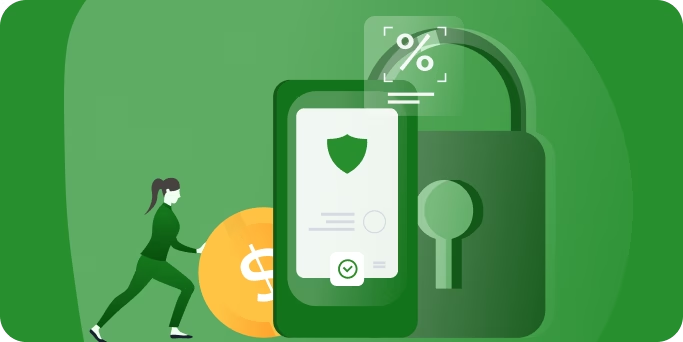
You want to build the next great fintech product. A payment platform. A lending marketplace. A wealth management app. But between PCI DSS, KYC/AML, state licensing, and federal regulation, the compliance puzzle feels impossibly complex.
The truth is this: fintech is one of the most heavily regulated app categories. But the regulatory structure is logical once you understand it. Here’s what you need to know in 2026.
The Regulatory Landscape
Fintech operates at the intersection of multiple regulatory frameworks. Unlike healthcare (which has HIPAA) or education (which has FERPA), fintech faces a patchwork of federal, state, and international rules. Each rule addresses a specific risk the financial system needs to manage.
The federal level includes the Federal Reserve, the Office of the Comptroller of the Currency (OCC), the Consumer Financial Protection Bureau (CFPB), and the Securities and Exchange Commission (SEC). Each agency writes rules for different parts of the financial system.
The state level matters too. Money transmission licenses are required in most states before you can handle customer funds. The requirements vary by state, which is why fintech founders often say state licensing is more painful than federal regulation.
International regulation depends on where your customers are. European fintechs face PSD2 and GDPR. If you operate globally, compliance complexity multiplies.
But here’s the framework that simplifies it: financial regulation addresses three core risks.
The Three Core Regulatory Risks
First, fraud and payment security. This is where PCI DSS (Payment Card Industry Data Security Standard) comes in. If your app handles credit cards, debit cards, or payment data, PCI DSS compliance is mandatory. PCI DSS requires encryption, secure transmission, access controls, and regular security testing.
Second, customer verification and money laundering. This is where KYC (Know Your Customer) and AML (Anti-Money Laundering) rules exist. KYC requires you to verify customer identity before they can transact. AML requires you to monitor transactions for suspicious patterns that might indicate illegal activity.
Third, consumer protection. The CFPB exists to ensure consumers aren’t exploited by financial products. If you’re offering lending, the regulations get stricter. If you’re offering investment advice, securities rules apply.
Understanding these three buckets helps you prioritize where to focus compliance resources.
PCI DSS: Non-Negotiable for Payment Processing
If your app processes payment cards, PCI DSS applies. Full stop. There are no exceptions.
PCI DSS has 12 main requirements organized into six control objectives. The framework requires you to maintain secure networks, protect cardholder data, maintain vulnerability management programs, implement strong access control measures, maintain an information security policy, and monitor and test networks regularly.
In practical terms, this means:
Your servers must be segmented. Cardholder data lives in an isolated network that doesn’t touch your general infrastructure. If an attacker compromises your marketing server or your admin tools, they shouldn’t have access to payment data.
All cardholder data must be encrypted at rest and in transit. When you’re storing card numbers or sensitive data, it’s encrypted. When it moves across your network, it’s encrypted. The encryption needs key management, meaning secure storage and rotation of encryption keys.
You need multi-factor authentication for anyone accessing payment systems. A password alone isn’t sufficient.
You must have audit logs. Every access to cardholder data is logged with timestamps and user identification. These logs can’t be modified after the fact.
You need to validate your network with regular penetration testing and vulnerability scanning. This is mandatory, not optional.
Compliance is verified through a Qualified Security Assessor (QSA). You don’t self-certify compliance. An external auditor confirms you meet the standard.
KYC and AML: Identity Verification and Transaction Monitoring
KYC is the foundation. Before a customer can do anything on your platform, you verify their identity. For most consumers, this means collecting their legal name, date of birth, address, and identification document (passport, driver’s license, or state ID). You verify the document is genuine and matches the person.
This isn’t data collection for marketing. It’s a legal requirement. Regulators want to ensure financial institutions know who their customers are.
AML goes further. After you’ve verified identity, you monitor transaction patterns for suspicious activity. Are withdrawals happening from impossible locations? Is the transaction size inconsistent with historical behavior? Is the customer sending money to high-risk jurisdictions? These are flags that trigger investigation.
In 2026, regulators are intensifying AML enforcement. Financial institutions must update customer risk profiles regularly, refresh KYC documentation periodically, and file Suspicious Activity Reports (SARs) when warranted. This isn’t a set-it-and-forget-it process. It’s ongoing.
For app developers, this means building screening and monitoring into your platform architecture. Many fintech companies use third-party KYC providers (like Onfido or Jumio) for identity verification. This outsources the complexity while ensuring compliance.
State Licensing: The Money Transmission License
If your app holds customer funds or facilitates transfers between customers, you likely need a Money Transmission License (MTL) in each state where you operate.
Money transmission licensing is state-by-state. There’s no federal MTL. So if you operate in 50 states, you might need 50 separate licenses. Some states have reciprocal agreements, which simplifies the process. But each license requires an application, compliance documentation, and fees.
The process takes months. States review your business plan, your security infrastructure, your compliance procedures, and your management team’s experience. If your compliance documentation is weak, the state will reject your application.
Once licensed, you face ongoing reporting requirements. Most states require quarterly or annual reporting on transaction volumes, customer counts, and compliance activities.
Money transmission licensing costs vary by state but typically range from $1,000 to $25,000 per state. For a multi-state fintech, licensing costs can reach $500,000+ just for the initial round. Budget this in your first year.
Some fintech companies avoid MTL requirements by partnering with a licensed partner. Instead of holding funds directly, you connect customers to a licensed financial institution. This is the partnership model. It’s slower than direct operation but avoids licensing complexity.
Get Your Free 45-Minute App Roadmap
Meet 1-on-1 with our senior product team. We’ll map your MVP or enterprise app and hand you a personalized plan—clear scope, a realistic timeline, and fixed monthly costs—for iOS & Android, web, tablets & wearables, and AI.
Encryption and Multi-Factor Authentication: Your Security Foundation
Beyond PCI DSS, good fintech security requires encryption and multi-factor authentication as baseline standards.
Encryption should be AES-256 at rest (stored data) and TLS 1.3 in transit (moving data). But encryption alone doesn’t ensure security. You need key management. Encryption keys must be stored securely, rotated regularly, and tracked carefully.
Multi-factor authentication means your customers can’t access accounts with a password alone. They need a second factor. This could be a one-time code sent via SMS, an authenticator app, biometric authentication, or a hardware security key.
For employees accessing sensitive systems, multi-factor authentication is mandatory. For customers, it’s strongly recommended and increasingly expected.
Session timeout is another critical control. Users shouldn’t stay logged in indefinitely. If a user is inactive for 15 minutes, the session expires. This prevents someone from accessing an unattended device.
The Compliance-First vs. Retrofit Trap
Here’s the biggest mistake we see fintech founders make: they build the product first and try to add compliance second.
This approach fails. Compliance can’t be bolted on top of architecture that wasn’t designed for it. You can’t add PCI DSS to a system that wasn’t built with network segmentation and encryption from the start. You can’t add KYC to a platform that wasn’t designed to verify customer identity upfront.
Compliance-first architecture means every decision is made with regulation in mind. How do you store data? Encrypted. How do you verify identity? Before any transaction. How do you log activity? Immutably, for audit trails. How do you separate payment data from other data? By design, not retrofit.
This approach adds cost upfront. You’re not building the minimum viable product and then compliance-ifying it. You’re building the compliant product from the start. But this cost is far less than retrofitting compliance into a system that wasn’t designed for it.
At Chop Dawg, we’ve built fintech platforms that passed PCI DSS audits on the first review because compliance was built into the architecture. We’ve helped companies avoid licensing delays because their compliance documentation was thorough from day one.
The cost difference between compliance-first and retrofit is staggering. Plan for compliance-first.
Data Breach Response: Critical Planning
Even with strong security, breaches happen. Your response plan matters as much as your prevention plan.
You need a written incident response plan that covers: detection and containment, evidence preservation, notification procedures, and regulatory reporting. When a breach is discovered, speed matters. You have limited time to notify customers and regulators.
You need cyber insurance that covers that covers financial liability. Breach notification costs money. Legal costs money. Regulatory penalties are expensive. Insurance mitigates financial risk.
You need to document your incident response process. Regulators will review this if a breach occurs.
Choosing Your Development Partner
Fintech development requires specific expertise. Not every app developer understands PCI DSS or KYC/AML compliance.
Questions to ask a potential partner:
- Have you built PCI DSS compliant payment systems? Ask for examples and references.
- How do you approach encryption and key management?
- Have you integrated KYC providers like Onfido or Jumio? How do you handle identity verification?
- Do you understand state money transmission licensing requirements?
- What’s your approach to security testing and penetration testing?
- How do you structure your architecture for compliance?
- Can you provide documentation for regulatory submissions?
- What’s your incident response process?
You should look for a partner with fintech experience, not just app development experience. Fintech is its own domain.
The Timeline Reality
Fintech founders often underestimate timeline. Building the app is one thing. Achieving compliance is another. Money transmission licensing can take 3-6 months per state. PCI DSS assessment takes 6-8 weeks. KYC integration takes 4-6 weeks.
If you’re launching in 10 states with an innovative payment mechanism, plan for 12-18 months from concept to launch. If you’re using a partnership model with an existing licensed provider, you can compress this to 6-9 months.
Budget time as carefully as you budget money. Regulatory delays are common and frustrating, but they’re not avoidable.
2026 Regulatory Priorities
In 2026, regulators are focusing intensely on data security. The CFPB is scrutinizing lending products for unfair practices. State banking regulators are examining KYC and AML procedures. The OCC is prioritizing cybersecurity compliance.
Data breaches and weak security controls are enforcement priorities. If you build security poorly, regulators will notice when they audit.
Planning for 2026 means taking security seriously, not as an afterthought. It means understanding that compliance isn’t a checkbox. It’s how you operate.
The Bottom Line
Fintech is heavily regulated because financial security matters. Customers entrust you with their money. Regulators ensure that trust isn’t misplaced.
The regulatory structure is complex, but it’s logical. Build compliance into your architecture from the start. Partner with experienced developers. Plan for longer timelines. Budget for licensing and audits. Take security seriously.
If you’re building fintech, you’re building for regulation. Accept that and plan accordingly.
Ready to build your fintech app with compliance built in from day one? Schedule a free 45-minute consultation with our fintech development team at chopdawg.com. We’ll walk through your regulatory requirements and help you build a compliant product that can scale.
Frequently Asked Questions
Do I need a money transmission license?
If your app holds customer funds or transfers money between customers, you likely need a Money Transmission License (MTL). MTLs are issued by states, not federally. Requirements vary by state, but most require compliance documentation, security procedures, and fees ($1,000-$25,000 per state). Partnership models that use licensed intermediaries can avoid MTL requirements but may be slower to market.
What’s the difference between KYC and AML?
KYC (Know Your Customer) is identity verification. Before customers can transact, you verify their legal identity with documents and background checks. AML (Anti-Money Laundering) is ongoing monitoring. After verification, you monitor transactions for suspicious patterns that might indicate illegal activity. KYC happens once at onboarding. AML is continuous.
Does PCI DSS apply to my fintech app?
If your app processes, stores, or transmits credit card data, debit card data, or payment card information, PCI DSS compliance is mandatory. This includes merchant platforms, wallet apps, lending marketplaces that accept payments, and payment processors. There are no exceptions. You must work with a Qualified Security Assessor (QSA) to verify compliance.
Can I start a fintech without state licensing?
It depends on your business model. If you facilitate transfers between customers or hold customer funds, you need MTL in each state. If you use a partnership model where a licensed partner holds funds and you provide the interface, you can avoid direct licensing. If you provide only consulting or information, licensing may not apply. Consult with a fintech attorney about your specific model.
How much does fintech compliance cost?
Compliance costs vary significantly. Initial PCI DSS assessment is roughly $15,000-$25,000. KYC/AML integration with third-party providers costs $5,000-$15,000. Licensing costs range from $1,000-$25,000 per state. Security infrastructure and encryption add development cost. Budget 20-30% of your development cost for compliance implementation, plus ongoing audit and licensing expenses.
What should I prioritize: compliance or product speed?
Prioritize compliance. Building a non-compliant product that you later retrofit for compliance costs far more than building compliant from the start. Compliance-first architecture is also more secure and trustworthy. Launch slower but compliant, rather than launching fast and facing regulatory delays or penalties.
How long does money transmission licensing take?
MTL applications typically take 3-6 months per state. If you need licenses in multiple states, you’re looking at 6-18 months depending on your strategy (simultaneous applications vs. phased rollout). Each state has different requirements and review processes. Start the licensing process early, not after your app is built.
What encryption standards do regulators expect?
Regulators expect AES-256 encryption for data at rest and TLS 1.3 for data in transit. Encryption alone isn’t sufficient. You need documented key management, regular key rotation, and secure storage of encryption keys. Auditors and regulators will ask for evidence of your encryption implementation.